Sourdough Starter: How to Make It, Feed It, and Fix It
How this guide was made: it is a researched guide compiled from the published sources listed at the end of this page. Each instruction is attributed so you can check it.
A sourdough starter is flour and water that has been fed until it carries a stable culture of wild yeasts and lactic acid bacteria. The yeasts make the gas that raises bread; the bacteria make the acids that give it its tang [12]. This guide covers making one from scratch, a feeding routine that fits your week, and what to do when it misbehaves.
What you need
- A kitchen scale (grams).
- A clear jar with a loose lid, so you can watch the rise.
- Flour. Whole-wheat or rye helps a new starter get going because whole grains tend to carry more wild yeast and food. Once the starter is established, all-purpose flour is fine [1][2].
- Water. Ordinary tap water is usually fine [1]. If yours is heavily treated and the starter struggles, try filtered water. Letting tap water sit out removes chlorine but not chloramine, which some utilities use [3][4].
Make a starter from scratch (about 1–2 weeks)
All amounts by weight. Keep the starter at about 70–78°F (21–26°C). If your home is below about 68°F, find a warmer spot (for example, the oven turned off with the light on) and check the temperature so it doesn't get too hot [1].
| Day | What to do |
|---|---|
| 1 | Mix 50 g whole-wheat (or rye) flour + 50 g water. Cover loosely. |
| 2 | You may see a few bubbles, or nothing. Leave it. |
| 3–7 | Keep 50 g of starter, discard the rest, add 50 g flour + 50 g water, stir. King Arthur does this twice a day, about 12 h apart, from day 3 [1]. |
| 7–14 | Keep feeding until it reliably doubles within about 6–8 h of a feed [1][7]. |
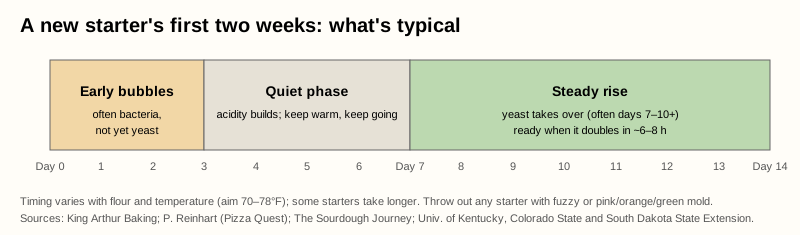
The "quiet phase" is normal. Many new starters bubble a lot in the first couple of days, then go flat for several days before the culture settles. Don't throw it out. The early burst often comes from bacteria (such as Leuconostoc) that die back as the mix gets more acidic. That acidity is what lets the yeast take over, which can stretch the process to 7–10 days [5][6]. Keep it warm and keep going. If it stays flat past about day 7, try spacing feeds further apart; frequent feeds dilute the acidity and can slow it down [6].
Is it ready to bake with?
Look for all of these within a few hours of a feed at warm room temperature: - It roughly doubles in volume (King Arthur and UK Extension both cite about 6–8 hours after a feed [1][7]), with a domed or just-starting-to-fall top. - Bubbles all the way through, not just on the surface. - A pleasant sour or yogurty smell.
None of the sources above rely on a float test. They judge readiness by rise, bubbles and smell [1][7].
Feeding ratios, and how they change the timing
Ratios are by weight: starter : flour : water.
| Ratio | Example | What it does |
|---|---|---|
| 1:1:1 | 50 g starter + 50 g flour + 50 g water | Peaks soonest [10]. |
| 1:2:2 | 25 g + 50 g + 50 g | Also a faster feed [10]. |
| 1:5:5 | 10 g + 50 g + 50 g | Peaks later. A common choice for an overnight build [10][11]. |
Peak times depend on temperature, flour and ratio; warm kitchens speed things up and cool ones slow them down [11]. Write down your starter's times; the printable log has a column for this.
Fridge routine (if you bake once a week)
- After a feed, let it rise for an hour or two, then refrigerate.
- Feed it about once a week.
- A day or two before baking, take it out and give it a couple of room-temperature feeds until it rises predictably again [13].
This routine follows King Arthur's guidance (refrigerated starter at least once a week) and University of Kentucky Extension [2][7]. A starter neglected for months can usually be revived with repeated feeds, but it takes longer [2].
Troubleshooting
Starter not rising - Common causes: too cool, too young, or a feeding schedule that doesn't match its activity [1][6]. - Move it somewhere warmer (70–78°F) [1]. A whole-grain feed can speed a starter up [2]. With a new starter that stalls, try longer gaps between feeds [6].
Grey or dark liquid on top ("hooch") - It's an alcohol-smelling by-product of fermentation, common when a starter has gone a while without a feed. It's fine: pour it off or stir it in, then feed [8][14].
Mold - Fuzzy spots, or pink, orange or green spots or streaks or discoloration, mean throw the whole starter out and start fresh. - Don't scrape it off and keep it. University extension services advise discarding a starter with any colored or fuzzy mold and thoroughly cleaning the container before starting over [8][9]. - Grey liquid (hooch) is not mold, and neither are whitish yeast clumps on an unfed fridge starter [8].
Too sour or too sluggish after the fridge - Give it a couple of room-temperature feeds, a day or two ahead, before baking [13].
Sourdough discard
Each time you discard, you can save it in a jar in the fridge for recipes that don't need a lively starter: crackers and pancakes, for example [7][14]. For the swap math, storage times and ways to make less discard, see Sourdough Discard: Use It, Store It, Make Less.
Related: - Baker's Percentages & Hydration Calculator - Printable Weekend Bake Schedule
Sources (checked 2026-10-17)
- King Arthur Baking, "Sourdough Starter" recipe (updated 2026-09-08): https://www.kingarthurbaking.com/recipes/sourdough-starter-recipe
- King Arthur Baking, Sourdough guide, "Maintain": https://www.kingarthurbaking.com/learn/guides/sourdough/maintain
- US EPA, "Common Health Questions Related to Monochloramine" (2009): https://www.epa.gov/sites/default/files/2015-09/documents/how_can_i_remove_monochloramine_from_my_drinking_water.pdf
- CDC, "About Water Disinfection with Chlorine and Chloramine": https://cdc.gov/drinking-water/about/about-water-disinfection-with-chlorine-and-chloramine.html
- Peter Reinhart, Pizza Quest "FAQ #1, Sourdough Starters" (Forno Bravo): https://www.fornobravo.com/pizzaquest/faq-1-sourdough-starters/
- The Sourdough Journey, "The Stall Point Test for New Sourdough Starters" (PDF): https://thesourdoughjourney.com/wp-content/uploads/2023/11/TSJ-The-Stall-Point-Test-for-New-Sourdough-Starters.pdf
- University of Kentucky Cooperative Extension, "The Science Behind the Rise: How Sourdough Starters Work" (PDF): https://fcs.mgcafe.uky.edu/sites/fcs.mgcafe.uky.edu/files/fn-amc_090-scienceofsourdough-pub-ada.pdf
- Colorado State University Extension, "Sourdough Starter Best Practices": https://extension.colostate.edu/resource/sourdough-starter-best-practices/
- South Dakota State University Extension, "Sourdough Starters": https://extension.sdstate.edu/sourdough-starters
- Boulie, "Levain Build Calculator" (ratio guidance): https://boulie.app/tools/levain-build-calculator/
- Dablew Tools, "Levain Calculator" (ratio guidance): https://dablewtools.com/baking/levain-calculator
- The Perfect Loaf, "Beginner's Sourdough Bread" (updated 2026-01-15): https://www.theperfectloaf.com/beginners-sourdough-bread/
- King Arthur Baking, "Sourdough schedule: How to plan your bread baking timeline" (2026-05-20): https://www.kingarthurbaking.com/blog/2026/05/20/sourdough-starter-feeding-schedule
- UC ANR Master Food Preserver blog, "Can This Sourdough Starter be Saved?": https://ucanr.edu/blog/master-food-preserver-slo-sb-counties/article/can-sourdough-starter-be-saved-or-starter-goner Note: sources [1] and [2] are both King Arthur. Corroboration for whole grains is weaker; the claim is kept as a soft "tends to".