Sourdough Discard: Use It in Any Recipe, Store It Safely, Make Less of It
How this guide was made: it is a researched guide compiled from the published sources listed at the end of this page. Each instruction is attributed so you can check it. The calculator and charts are our own arithmetic.
Sourdough discard is the part of your starter you take out before a feed, so the jar doesn't keep growing and the culture has fresh food to work with [1][17]. It is still flour and water, now sour and full of microbes, and it doesn't have to go in the bin. This page covers three things the usual recipe lists skip: - the exact math for swapping discard into a recipe you already like, for any starter hydration, with a calculator; - how long discard keeps, with the published advice side by side (it disagrees); - how to make less of it in the first place, with grams per week for common routines.
If you're still building a starter, start with our Sourdough Starter guide. King Arthur and Food Republic both say not to save discard from a starter that isn't yet established [1][20].
Quick answers
- What it is: unfed starter removed at feeding time [1][18].
- What it does in a recipe: mostly adds flavour, acidity and moisture. It adds little lift, so keep the recipe's yeast, baking soda or baking powder [1][3][4][18].
- Swap rule for a 100% starter: half of the discard's weight is flour and half is water; take those amounts out of the recipe [1][3][4].
- Fridge life: published answers range from about a week to months, and no food-safety agency gives a figure (see the storage table).
- Never eat it raw. It's raw flour; cook or bake it first [12][13].
How to swap discard into any recipe
Discard isn't an extra ingredient. It replaces some of the flour and liquid the recipe already has. Add discard without taking anything out and the batter ends up wetter and heavier than written [1][2].
Step 1: split the discard into flour and water
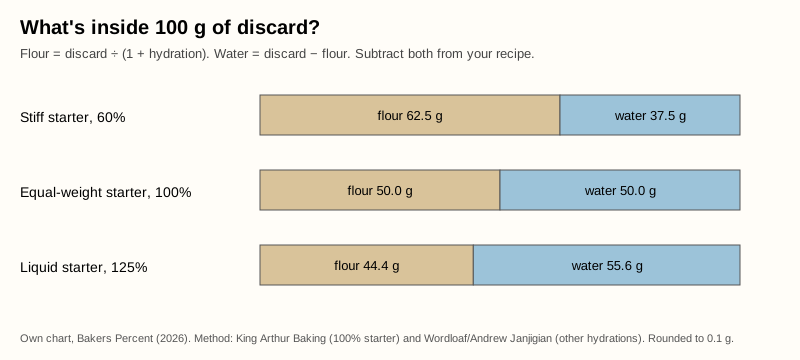
- Starter at 100% hydration (equal weights of flour and water): divide the discard weight by 2. That gives the flour, and the rest is water [1][3][4].
- Any other hydration: flour = discard ÷ (1 + hydration as a decimal); water = discard − flour [3].
Step 2: take those amounts out of the recipe
Subtract the discard's flour from the recipe's flour. Subtract its water from a liquid that behaves like water: water, milk or buttermilk [2][4].
Don't count these as liquid to swap out [2]: - oil or melted butter (mostly fat); - honey or syrup (mostly sugar).
Worked example 1 (100% starter). - Recipe: 360 g flour and 300 g buttermilk. You have 120 g discard. - 120 g ÷ 2 = 60 g flour + 60 g water. - New recipe: 300 g flour, 240 g buttermilk, 120 g discard. Everything else stays the same. - Share of the flour now coming from discard: 60 ÷ 360 = 16.7%.
Worked example 2 (stiff starter at 60%). - Recipe: 250 g flour and 200 g milk. You have 120 g discard. - Flour in the discard = 120 ÷ 1.6 = 75 g; water = 120 − 75 = 45 g. - New recipe: 175 g flour, 155 g milk, 120 g discard. - Discard now supplies 75 ÷ 250 = 30% of the flour. - Note that using the 100% rule here (taking out 60 g of each) would leave the mix with 15 g too much flour (250 − 60 + 75 = 265 g) and 15 g too little liquid (200 − 60 + 45 = 185 g), so it would come out stiffer than the original.
Step 3: check you're not overdoing it
Sources suggest different starting limits. All of them are rough guides, not hard rules:
| Source | Suggested starting amount |
|---|---|
| King Arthur Baking | Substitute discard for no more than ⅓ of the recipe's flour at first; raise it next time if you like the result [1]. This guide (and the calculator) reads that as the discard's flour being at most a third of the recipe's flour. A stricter reading (discard weight at most a third of the flour weight) halves the amount for a 100% starter |
| Pantry Mama | No more than 200 g of discard per recipe [5] |
| Amy Bakes Bread | Usually 100–200 g [4] |
| Wordloaf (Andrew Janjigian) | When developing recipes, at most half of the flour from discard, then less if needed. The flour in discard is too broken down to give much structure [3] |
Worked example 3 (too much). - Recipe: 250 g flour and 120 g milk. You want to use 400 g of 100% discard. - That's 200 g flour + 200 g water, but the recipe only has 120 g of liquid to give up. - The most this recipe can absorb is 120 × 2 = 240 g of discard. - At King Arthur's one-third starting point, it's (250 ÷ 3) × 2 ≈ 167 g.
Discard swap calculator
| Result | Grams |
|---|
The discard is split into flour and water by its hydration, then that much is taken out of the recipe. Weights are rounded to the nearest gram. Don't count oil, honey or melted butter as "liquid you can reduce"; eggs are a special case (see the guide). The one-third starting point follows King Arthur Baking's suggestion, read as the discard's flour being at most a third of the recipe's flour.
The calculator only handles flour and liquid. To check the total hydration of a bread dough that includes ripe starter, use the baker's percentage and hydration calculator.
Which recipes take discard well
Good candidates: recipes that already contain a fair amount of water-like liquid: - pancakes, waffles, muffins, quick breads, snacking cakes, biscuits and scones [1][2]. - Recipes made with buttermilk are a strong fit. Discard's acidity can stand in for buttermilk's tang, and the recipe's baking soda tempers the sourness. Wordloaf suggests adding nonfat dry milk to replace the milk solids you lose [3]. - Crackers: thin, dry bakes tend to taste less sour than the discard itself. Wordloaf's explanation is that acetic acid can evaporate during baking [3].
Poor candidates: recipes held together by fat with little water: - Cookies: often too little liquid to swap [1][2]. Amy Bakes Bread swaps a whole egg for just a yolk in cookies to make room for discard [4]. - Shortbread and flaky pie dough: wet discard flour tends to make them harder or tougher [3]. - Egg-heavy recipes: they can work, but the discard adds water on top of the eggs, so you may need a little more flour [3].
Other things to expect: - Milk: swapping out milk loses some of its fat and milk solids, so expect a small change in flavour and texture [2]. - Texture: in a mix, discard acts closer to a liquid than to flour, so batters can turn out stickier or runnier than usual. Hold back a little liquid and adjust [5]. - Flour type: a rye or whole-wheat discard is best swapped for whole-grain flour, not for the white flour that gives a loaf its structure [3].
How long does sourdough discard last?
Short version: keep it in a lidded jar in the fridge, date it, and use the oldest first. Freeze what you won't use soon. Throw it out at any sign of mold.
What the sources say
Sources agree on the method but not on the time:
| Source (type) | Fridge | Freezer | Counter |
|---|---|---|---|
| Food Republic (food media) | up to 1 week [20] | — | — |
| Pantry Mama (blog) | use within 1 week; it gets very sour after that [15] | — | — |
| The Clever Carrot (blog) | about a week [14] | a few months [14] | 1–2 days at ~70°F [14] |
| The Perfect Loaf (blog) | freshest for about 2 weeks [16] | — | — |
| sourdoughstarter.com (starter seller) | up to 2 weeks [24] | up to 3 months [24] | can spoil within ~48 h [24] |
| King Arthur Baking (baking publisher) | several weeks [1] | — | fine if you'll use it that day [1] |
| Baker Bettie (blog) | starts a new jar about monthly [17] | — | — |
| Zero-Waste Chef (blog) | many months if you keep adding and removing; untouched for weeks it gets very sour [18] | has kept it 6 months [18] | — |
| Girl Versus Dough (blog) | "months" [21] | — | — |
| University extension and US government (CSU, SDSU, UKY, UC ANR, K-State, Univ. of Missouri, FDA, CDC) | No discard-specific time given [6]–[13] | — | — |
How to read this: - The cautious end of the range is about a week [14][15][20]. - The longer figures come from a baking publisher and bloggers, not from food-safety agencies [1][16][17][18][21]. - The extension services do give general rules that apply here: - keep the fridge at 34–40°F and the freezer at 0°F or below [10][11]; - label and date containers [9][10]; - use food quickly instead of counting on the maximum storage time [10][11]. - Older discard mainly gets more sour and runnier, which suits savoury bakes better than sweet ones [2][4][15][18].
Storage how-to
- Fridge: use a jar with a lid. You can keep adding each feed's discard to the same jar [1][17].
- Freezer: freeze it in small, labelled portions [9][14]. Thaw it in the fridge, not the microwave [14][18].
- Counter: only if you'll bake with it soon [1][14].
When to throw it out
- Any mold, fuzzy or coloured (pink, orange, green), or a foul smell: throw out the whole jar and wash the container well. Don't scrape off the mold and keep the rest [6][7][8].
- Pink or orange streaks: throw it out [1][7].
- Where sources disagree: Zero-Waste Chef scoops off a little white mold [18]. The university extension guidance is to discard a starter that shows any mold [6], so this guide follows the extension advice.
- Not a reason to throw it out: grey or dark liquid on top (hooch). It's alcohol from fermentation. Pour it off or stir it in [1][6][20].
- Don't pour it down the sink. It can clog pipes. Use the bin or compost [1][17].
How to make less discard
The quickest win is shrinking the amount of starter you keep. For a 1:x:x feed (starter : flour : water by weight), here's what happens if none goes into a bake: - You keep a seed of S grams and feed it x·S of flour and x·S of water. - Next time, you remove everything except S again. - So each feed produces 2 × x × S grams of discard.
| Routine (illustrative) | Discard per feed | Per week |
|---|---|---|
| Counter, keep 50 g, 1:1:1, twice a day | 100 g | 1,400 g |
| Counter, keep 50 g, 1:1:1, once a day | 100 g | 700 g |
| Counter, keep 5 g, 1:3:3 (Baker Bettie's "micro-feed" [17]), once a day | 30 g | 210 g |
| Counter, keep 10 g, 1:1:1, once a day | 20 g | 140 g |
| Fridge, keep 50 g, 1:1:1, once a week | 100 g | 100 g |
| Fridge, keep 10 g, 1:1:1, once a week | 20 g | 20 g |
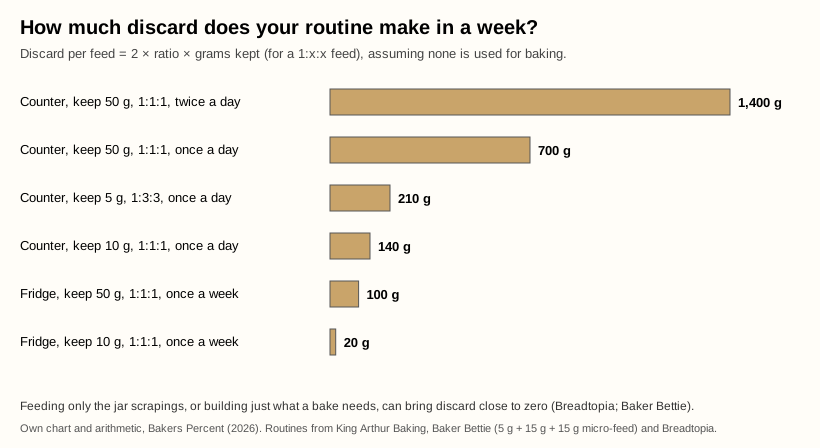
Two things stand out: 1. The fridge does the most work. A refrigerated starter needs feeding only about once a week [7][8][17]. See the fridge routine in our starter guide. 2. A bigger feed ratio makes more discard from the same seed, even though it slows the rise [19]. A 1:5:5 feed from a 10 g seed builds 110 g of starter. If you don't bake with it, 100 g of that becomes discard at the next feed.
Ways to get close to zero: - Micro-feeds on non-baking days: keep a few grams and give them a small feed [17]. - Feed the scrapings. After you take out what a dough needs, feed the thin layer left in the jar and refrigerate it [19]. - Build only what the bake needs. If a recipe calls for 100 g of ripe starter, build 10 g + 50 g flour + 50 g water = 110 g the night before (the 1:5:5 overnight build in our weekend schedule). Use 100 g and keep 10 g as the next seed. - Use small amounts. Smaller amounts mean you'll want a scale that reads single grams; the baker's percentage guide explains why weighing matters.
What to do with sourdough discard (besides throwing it away)
These are uses only, linked to the collections that publish full recipes. This page does not reproduce them: - Breakfast: pancakes, waffles, muffins, biscuits, scones, granola [1][22]. - Savoury: crackers, pizza crust, flatbreads [1][3][22][23]. - Cakes and quick breads: banana bread, snacking cakes, buttermilk-style bakes [1][3][22]. - Bread made with unfed starter: King Arthur has bread recipes written for it. It notes the starter should have been fed within the past week [1]. - Not for eating: - feed it to start a new starter, or give it to a friend [1]; - dry it as a backup starter [17]; - compost it [17].
Full recipe collections: King Arthur's discard recipes [22] and The Perfect Loaf's discard archive [23].
FAQ
Is sourdough discard the same as sourdough starter? It's the same culture, just removed before a feed instead of being fed. It has less life in it than a freshly fed starter, which is why it adds flavour but not much rise [1][18].
Do I have to discard at all? For a healthy, manageable starter, King Arthur says yes [1]. Baker Bettie and Breadtopia show ways to keep the amount tiny, or close to none [17][19]. See How to make less discard.
Can you eat sourdough discard raw? No. Discard is raw flour and water. The FDA and CDC say not to eat raw flour, dough or batter, because only cooking kills germs such as E. coli and Salmonella [12][13].
Can sourdough discard make bread rise? Not reliably on its own. Discard recipes usually rely on yeast or baking soda/powder for lift [1][4][18]. King Arthur does publish breads made with unfed starter from a starter fed within the past week [1].
Can you freeze sourdough discard? Yes. The published figures run from about 3 months [24] to "a few months" [14], and Zero-Waste Chef reports keeping it for 6 months [18]. Freeze it in small labelled portions and thaw it in the fridge [9][14].
There's dark liquid on my discard. Is it bad? No. That's hooch, an alcohol by-product. Pour it off or stir it in [1][6]. Mold, or pink or orange colour, is the reason to throw it out [6][7].
Can I put discard down the drain? No. It can clog pipes. Put it in the bin or compost [1][17].
Can I use discard from a brand-new starter? Wait until the starter is established and rising reliably [1][20]. The starter guide shows what "ready" looks like.
Related: - Sourdough Starter: How to Make It, Feed It, and Fix It - Baker's Percentages & Hydration Calculator - Printable Weekend Bake Schedule
Sources (checked 2026-10-17)
- King Arthur Baking, "What is sourdough discard? And what should I do with it?" (2024-04-18): https://www.kingarthurbaking.com/blog/2024/04/18/sourdough-discard
- King Arthur Baking (PJ Hamel), "Adding sourdough to a recipe" (2015-10-29): https://www.kingarthurbaking.com/blog/2015/10/29/adding-sourdough-recipe
- Andrew Janjigian, Wordloaf, "Wordloaf's rules for sourdough discard recipes": https://wordloaf.substack.com/p/wordloafs-rules-for-sourdough-discard
- Amy Bakes Bread, "How to Add Sourdough Discard to Any Recipe" (updated 2026-06-16): https://amybakesbread.com/how-to-add-sourdough-discard-to-any-recipe/
- The Pantry Mama, "How To Add Sourdough Discard To Any Recipe" (updated 2024-10-08): https://pantrymama.com/how-to-add-sourdough-discard-to-any-recipe/
- Colorado State University Extension, "Sourdough Starter Best Practices": https://extension.colostate.edu/resource/sourdough-starter-best-practices/
- South Dakota State University Extension, "Sourdough Starters": https://extension.sdstate.edu/sourdough-starters
- University of Kentucky Cooperative Extension, "The Science Behind the Rise: How Sourdough Starters Work" (PDF): https://fcs.mgcafe.uky.edu/sites/fcs.mgcafe.uky.edu/files/fn-amc_090-scienceofsourdough-pub-ada.pdf
- UC ANR Master Food Preserver blog, "Can This Sourdough Starter be Saved?": https://ucanr.edu/blog/master-food-preserver-slo-sb-counties/article/can-sourdough-starter-be-saved-or-starter-goner
- Kansas State University Research and Extension, MF3130 "Safe Food Storage: The Refrigerator and Freezer" (PDF, hosted by UC ANR): https://ucanr.edu/sites/default/files/2023-07/386558.pdf
- University of Missouri Extension, MP558 "Storing Food in the Refrigerator": https://extension.missouri.edu/publications/mp558
- US FDA, "Handling Flour Safely: What You Need to Know": https://www.fda.gov/food/buy-store-serve-safe-food/handling-flour-safely-what-you-need-know
- CDC, "Raw Flour and Dough": https://www.cdc.gov/food-safety/foods/no-raw-dough.html
- The Clever Carrot, "Sourdough Discard 101: Recipes & FAQs Answered": https://www.theclevercarrot.com/2020/10/sourdough-discard-101-recipes-faqs-answered-pancakes/
- The Pantry Mama, "How Long Does Sourdough Discard Last In The Fridge?": https://pantrymama.com/how-long-does-sourdough-discard-last-in-the-fridge/
- The Perfect Loaf (Maurizio Leo), "My Sourdough Starter Cache: How I Keep Discard for Weeks" (updated 2024-07-04): https://www.theperfectloaf.com/my-sourdough-starter-cache-how-i-keep-discard-for-weeks/
- Baker Bettie, "How to Reduce and Use Your Sourdough Discard" (updated 2021-01-06): https://bakerbettie.com/sourdough-discard/
- Zero-Waste Chef (Anne-Marie Bonneau), "How to Manage Your Jar of Sourdough Discard": https://zerowastechef.com/2022/08/04/manage-sourdough-discard/
- Breadtopia (Melissa Johnson), "Sourdough Starter Management: A Zero-Discard Method" (2023-03-04): https://breadtopia.com/sourdough-starter-management-a-zero-discard-method/
- Food Republic, "Should You Store Your Sourdough Discard In The Fridge?": https://www.foodrepublic.com/1545060/store-sourdough-discard-fridge/
- Girl Versus Dough, "Sourdough Discard Recipes": https://www.girlversusdough.com/sourdough-discard-recipes/
- King Arthur Baking, "Sourdough Discard Recipes" (collection): https://www.kingarthurbaking.com/recipes/collections/sourdough-discard-recipes
- The Perfect Loaf, "Sourdough Discard" recipe archive: https://www.theperfectloaf.com/category/recipes/sourdough-discard/
- sourdoughstarter.com, "How to Store Sourdough Discard" (a starter seller's guide): https://sourdoughstarter.com/blogs/bakers-playbook/how-to-store-sourdough-discard
Notes: - The storage times in [14]–[18], [20], [21] and [24] are the authors' experience or editorial guidance, not lab data. - Sources [6]–[13] are university extension services and US government agencies. None of them gives a shelf life specific to discard. - The weekly-discard figures and the worked examples are our own arithmetic, shown step by step above.