Baker's Percentages and Hydration, Explained (with a Calculator)
How this guide was made: it is a researched guide compiled from the published sources listed at the end of this page. Each instruction is attributed so you can check it.
Every bread recipe can be written as one short list of percentages. Once you can read that list, you can scale any loaf up or down, tell at a glance how wet a dough will feel, and fix a recipe that isn't working. This page shows how the math works, then gives you a calculator that does it for you.
| Ingredient | Grams | Baker's % |
|---|
Baker's % is relative to total flour (flour you add + flour inside the starter). Weights are rounded to the nearest gram.
The one rule: flour is always 100%
In baker's percentages, every ingredient is measured by weight and written as a percentage of the total flour weight. Flour is always 100%, so the other numbers can add up to well over 100%. That's normal.
| Ingredient | Grams | Baker's % |
|---|---|---|
| Flour | 1,000 | 100% |
| Water | 750 | 75% |
| Salt | 20 | 2% |
To get any ingredient's percentage, divide its weight by the flour weight and multiply by 100. Going the other way, multiply the flour weight by the percentage: 1,000 g × 2% = 20 g salt.
Why weigh instead of using cups? America's Test Kitchen found up to a 20% difference in the weight of a cup of flour depending on how it's filled [1]. One home test of 192 cups of all-purpose flour weighed between 124 g and 144 g per cup [2]. Percentages only work with a scale.
What "hydration" means
Hydration is the water weight divided by the flour weight. A 75% hydration dough has 75 g of water for every 100 g of flour.
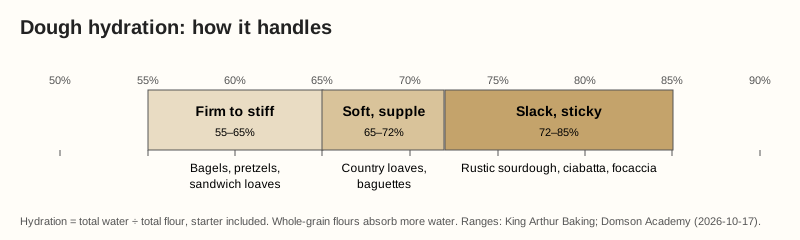
As a rough guide to how a dough handles [3][4]:
- About 55–65%: firm to stiff. Bagels and pretzels sit at the low end; sandwich loaves around 60–65%.
- About 65–72%: soft and supple. Typical of country loaves and baguettes.
- About 72–85%: slack and sticky. Rustic sourdough, ciabatta and focaccia. Usually gives a more open, irregular crumb, but takes more practice to shape.
- Whole-grain flours absorb more water, so whole-grain doughs often need, and can handle, higher hydration. Some even exceed 100% [3].
Don't forget the water inside your starter
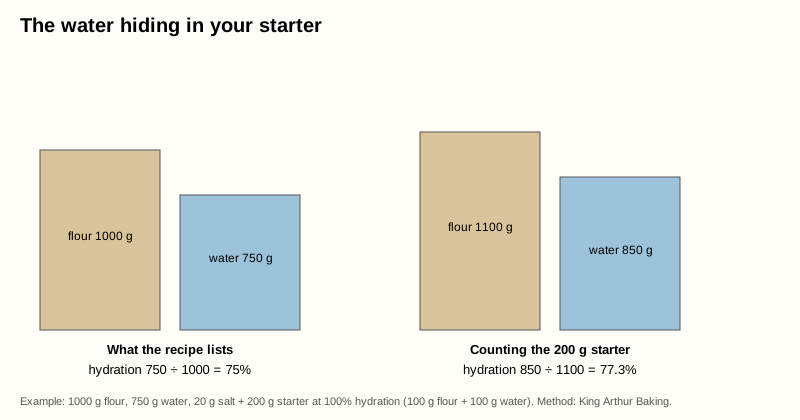
Sourdough recipes add a starter (levain), which is itself flour and water. A starter kept at 100% hydration is half flour, half water by weight. That hidden flour and water change your real hydration [3].
Worked example: - Flour 1,000 g, water 750 g, salt 20 g, plus 200 g of 100%-hydration starter. - The starter adds 100 g flour and 100 g water. - Total flour = 1,100 g, total water = 850 g. - True hydration = 850 ÷ 1,100 = 77.3%, not 75%.
That's why two recipes that both say "75%" can feel different. Our calculator always shows total hydration, starter included.
Two ways recipes describe the starter amount
- Starter as a % of flour: "20% levain" usually means 200 g of starter per 1,000 g of the flour you add. The Perfect Loaf lists "levain in final dough 20.3%" this way [7].
- Prefermented flour %: the share of total flour that is already in the starter. In the example, 100 ÷ 1,100 = 9.1%. The same Perfect Loaf recipe lists this as "pre-fermented flour 7.5%" [7].
The calculator uses method 2 because it keeps hydration exact. If a recipe uses method 1, roughly halve the starter percentage for a 100% starter: 20% levain ≈ 10% prefermented flour.
Salt
King Arthur's professional reference and the American Society of Baking both put salt in bread at 1.8–2% of flour weight [5][6]; 2% is a common default. Salt slows fermentation [5] and strengthens gluten [4]. Weigh it rather than using spoons.
How to scale any recipe in 3 steps
- Convert the recipe to percentages (each ingredient ÷ flour).
- Decide your total dough weight. Published single loaves are often in the 700–900 g range. The Perfect Loaf's beginner recipe is 1,800 g for two loaves [7]; King Arthur's Dutch-oven sourdough is roughly 700 g for one [8].
- Total flour = dough weight ÷ (1 + all percentages as decimals). With 75% water and 2% salt: 900 ÷ 1.77 = 508 g flour. Then multiply out each ingredient.
The calculator does steps 2–3 for you, including the starter.
Quick reference
| You want… | Change |
|---|---|
| Easier-to-handle dough | Lower hydration a few points; lower hydration feels firmer [3][4] |
| More open crumb (with practice) | Raise hydration a few points per bake [3][10] |
| Faster rise | Ferment warmer [7], or use more starter |
| Slower, more flexible schedule | Ferment cooler or use the fridge; recipes with very little starter can need 8–12 h of bulk [9] |
FAQ
Is 100% hydration starter the same as "1:1:1"? Feeding 1 part starter to 1 part flour to 1 part water by weight keeps a starter at 100% hydration. See our Starter Care Guide.
Does the starter count toward the salt percentage? Salt is calculated on total flour, including the starter's flour, in this calculator.
My dough feels wetter than the number says. Check whether the recipe's hydration includes the starter's water. Flour type matters too: whole-grain flours absorb more water [3].
Related: - Sourdough Starter Care Guide - Printable Weekend Bake Schedule
Sources (checked 2026-10-17)
- America's Test Kitchen, "Measuring Flour": https://www.americastestkitchen.com/how_tos/6573-measuring-flour
- Cupcake Project, "How Much Is a Cup of Flour in Grams?" (192-cup test): https://www.cupcakeproject.com/how-much-does-a-cup-of-flour-weigh/
- King Arthur Baking, "Hydration in bread dough, explained" (2023-01-11): https://www.kingarthurbaking.com/blog/2023/01/11/bread-hydration
- Domson Academy, "Baker's percentage" (hydration ladder table): https://domson.co.uk/gb/academy/recipes/bakers-percentage-fundamentals
- King Arthur Baking (Pro), "Salt": https://www.kingarthurbaking.com/pro/reference/salt
- American Society of Baking, "Salt": https://asbe.org/article/salt/
- The Perfect Loaf, "Beginner's Sourdough Bread" (updated 2026-01-15): https://www.theperfectloaf.com/beginners-sourdough-bread/
- King Arthur Baking, "Crusty Dutch Oven Sourdough Bread" (updated 2026-09-28): https://www.kingarthurbaking.com/recipes/crusty-dutch-oven-sourdough-bread-recipe
- King Arthur Baking, "Sourdough schedule: How to plan your bread baking timeline" (2026-05-20): https://www.kingarthurbaking.com/blog/2026/05/20/sourdough-starter-feeding-schedule
- Doughlab, "Hydration Index": https://dough-lab.com/resources/hydration-index Source [3] also confirms that starter flour and water count toward hydration.